


If you are, this handy 4 part guide is for you!
If like us an African Big Game Safari is on your bucket list then this four part Safari guide is for you. It covers the following points:
- When and where to visit – Part 1
- Public or private park and group or private safari – Part 2
- Self guided or private safari and what type of vehicle – Part 3
- Accommodation and extras – Part 4
So when Grete Howard, a friend through blogging and the most well travelled person I know, got in contact and asked if she could write a series of articles regarding planning an African Safari for our site, we jumped at the chance.
Grete has travelled extensively in Africa over the last 30 years, including a number of safaris taking in most of the well-known parks in East, South and West Africa.
She is passionate about photography and obsessive about travel, with Africa being her favourite continent and animals being her favourite subject.
As you will see throughout this series, Grete’s photographs are phenomenal and if you would like to check out more of them head over to her Flickr account.

Grete the Photographer
Thinking about your first safari can certainly be a daunting prospect: there are so many places to go and so many choices to make; it’s hard to know where to begin. Many people – like we did for our first safari – choose a package from their favourite travel operator without much thought to the contents.
With a little bit of planning, however, you can get something that is perfect for your taste and budget, and a trip which will hopefully turn out to be that ‘holiday of a lifetime’ you have been dreaming about!

Leopard in a tree in Taragire National Park, Tanzania
One thing I would like to state quite clearly is that a safari is not a holiday as such in the traditional sense; it has to be seen more as an adventure. The days are long, the conditions are rough, the weather is unrelenting, the roads are bumpy, the vehicle gets uncomfortable after a while, but the rewards are well worth any discomfort along the way. A safari is like no other holiday you will ever take.
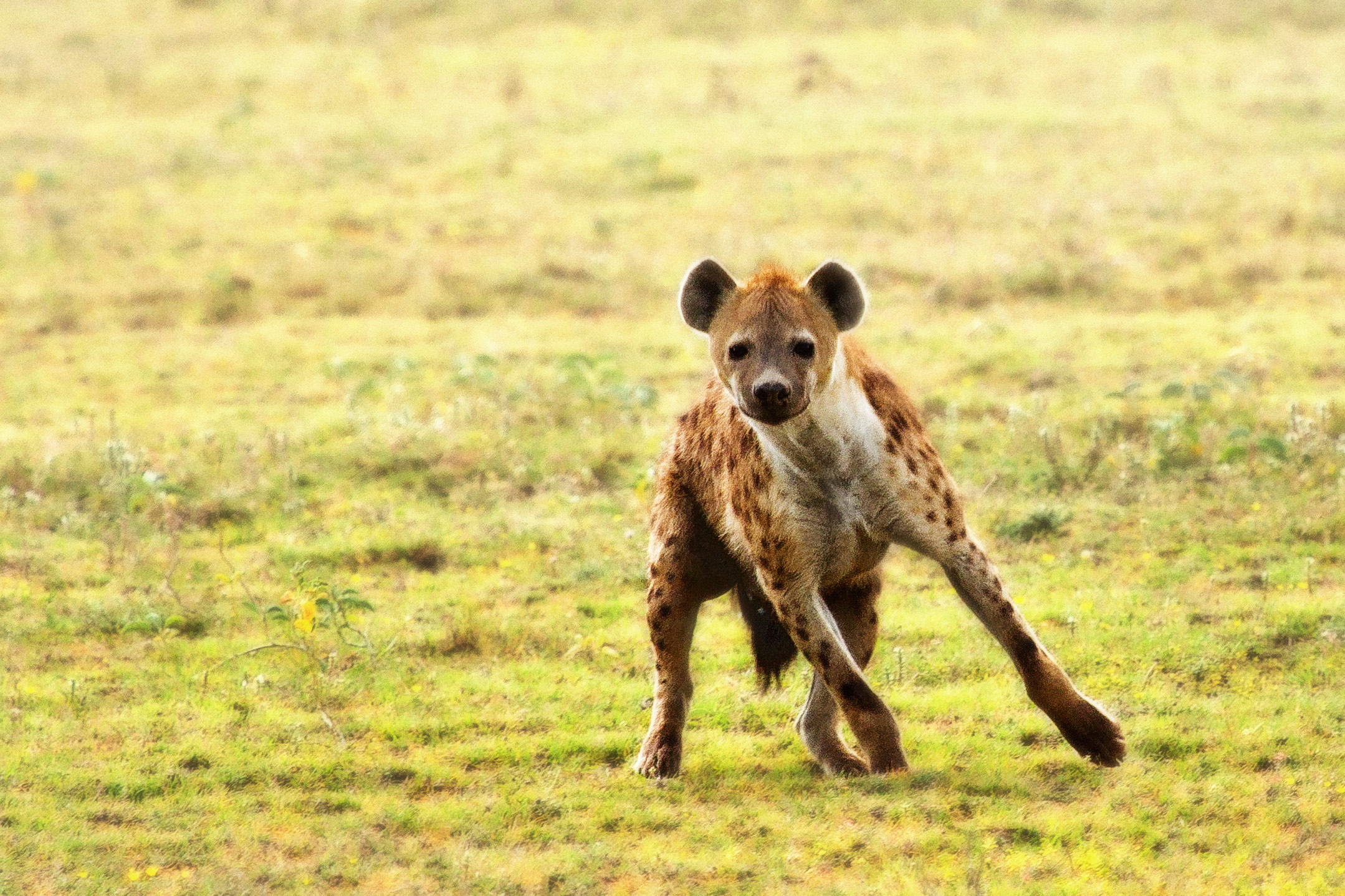
spotted hyena in Serengeti National Park, Tanzania
When to go
If you have a set time of year you want to travel, this could have a bearing on where you will get your best animal viewing opportunities.
As you can see from the chart below, some months are better for a safari in certain countries than in others. This is just to be used as a general guide however, as there are variations within each country and even within individual parks.

When is the best time to take a safari?
Where to go
This then leads us on to which country to visit. There are a number of ways to decide this – cost, availability of flights, which animals you want to see (some animals are only found in certain parks), time of year (as above), political stability, visa regulations amongst others.

The elusive caracal at Nduti, Tanzania
The main contenders in Africa are:
Botswana – very upmarket, mostly very expensive, some amazing eco-lodges, excellent game viewing.
Kenya – excellent game viewing (especially in the Masai Mara), but can be crowded and touristy. Great for combining with chill time on the beach.
Namibia – great for self-drive safaris, very dry desert-like habitat, animals not in such abundance as Botswana, Kenya or Tanzania.
South Africa – the best infrastructure of all the countries, but can for that reason seem much less ‘wild’. Lots of other sightseeing you can combine with a safari if you want a more varied holiday.
Tanzania – here you get superb wildlife viewing and wilderness experiences, good infrastructure and a range of lodges. Not as many tourists as in Kenya, but also not as many extracurricular activities.

Coming face to face with man’s closest relative is a moving experience
Uganda – excellent for gorilla tracking, probably the least developed infrastructure. Animals are not present in the same abundance as Botswana, Kenya or Tanzania.
Zambia – good game viewing, but not greatly developed infrastructure. Would appeal more to seasoned safari-goers.
Zimbabwe – probably the cheapest out of these destinations, but also the least stable politically.

A tower of reticulated giraffes in Samburu National Park, Kenya

Are you confused yet?
Summary – my personal choice
Having been lucky enough to make several visits to all the countries mentioned above over the last thirty years, at several different times of the year and staying in a number of different styles of accommodation, my choices would be:

A male lion is finishing off his breakfast in the Serengeti, Tanzania
When to go – end of May
While July and August are great times to spot the animals as the weather is dry and they tend to congregate around waterholes and rivers, it is also the most popular time so it can be incredibly busy at a sighting.

Lion Traffic Jam!
My favourite time to go is the end of May. As it is technically considered to be the latter part of the Green Season, the chances are that you could experience some rain, but I feel the benefits outweigh the disadvantages:
1. Lower cost – being the ‘shoulder season’ means that you can get more for your money.
2. Fewer people. The difference between the crowds in May and July is unbelievable! In May the most vehicles we have ever experienced at a sighting is 9. By comparison, it is nothing unusual to have to queue up to see a leopard or lion sighting in the height of the season, with up to 40 vehicles ‘waiting in line’.

We spent 40 minutes with this young lion cub, his brother and mum in Ngorongoro as the only vehicle present in May
3. Flowers. During the popular dry season, the vegetation dries out and turns a uniform brown. Not only does that pose all sorts of problems for photography, it isn’t particularly attractive. At the end of the rainy season, however, everything is lush and green, with some areas covered in a blanket of flowers.

Malanja Depression in the Ngorongoro Highlands, Tanzania
4. The flowers in turn attract birds, in great numbers. Even if you are not an avid bird watcher, you cannot fail to be impressed by some of the colourful species present at this time.

Variable sunbird at Ndutu, Tanzania
5. Dust – or rather: the lack of it. Dust can play havoc with your respiratory system, your camera equipment, and gets everywhere! In the Green Season there is less dust so you generally get clearer skies, which is better for spotting and photography.
6. The wildebeest migration tends to congregate around Central Serengeti at this time of year, so is fairly easily accessible on even a short safari.
Country – Tanzania
Reasons:
- The quality of the guiding – the driver-guides we’ve used in Tanzania have been consistently excellent, compared with other countries where they can be a bit hit-and-miss.
- The vastness of the reserves – the Serengeti is enormous, thus having more space for tourists to be spread out, unlike the Masai Mara for instance. You can sometimes drive for hours without seeing a single other vehicle, even in the high season!
- The abundance of wildlife. Taking friends on their first safari recently, they were concerned about how many animals we might see, especially as we were travelling in the ‘shoulder’ season; and also having heard my story about travelling to Kenya in 1993 and not seeing a single lion all week. In eight days of safari we saw literally hundreds of elephants, 93 (!) lions, 6 cheetahs, 2 leopards and more ungulates that you could imagine possible!

Zebra and Wildebeest at Hidden Valley, Ndutu
- The Great Migration spends 80% of the time in Tanzania, and can been seen almost year round at different places.Seeing the famed crossing at Mara River is an awesome experience, but not one that I would necessarily recommend for someone on their first-time safari, as a lot of time is spent sitting around waiting for the action.
We spent 12 hours a day for three days just waiting for three crossing totalling 20 minutes of action
Even if you don’t go all the way to the north to the border with Kenya to see the animals cross the Mara River, being in the midst of several hundred thousand wildebeest is an experience you are unlikely to forget in a hurry.
Being surrounded by so many wildebeest is an onslaught on all the senses; sound, smell and sight!
- All the tracks in the parks are left unpaved so you get a much more sense of true wilderness (unlike places like South Africa where the paved roads could remind you of a safari park back home).
Would this image be the same if the road was tarmac
- Unlike some of the other neighbouring countries, Tanzania is very stable politically.
- The parks of the Northern Circuit (Tarangire, Lake Manyara, Ngorongoro and Serengeti) are located close enough together that they can be combined during a one-week safari for variety of vegetation and animals.


• All photographs provided by Grete Howard


3 Comments
Africa: Planning a Big Game Safari, Part 2 – What Park & What Safari? – Eat Sleep Love Travel
17/08/2016 at 2:54 pm[…] When and where to visit – Part 1 […]
Africa: Planning a Big Game Safari, Part 3 – Self-drive/Guided & What Vehicle – Eat Sleep Love Travel
18/08/2016 at 7:03 am[…] When and where to visit – Part 1 […]
Africa: Planning a Big Game Safari, Part 4 – Accommodation, Add-ons & Operator – Eat Sleep Love Travel
18/08/2016 at 1:06 pm[…] When and where to visit – Part 1 […]